Greek Desserts · The Mainland · Baked · Easter
Koulourakia Recipe (Greek Easter Butter Cookies)
Κουλουράκια koo-loo-RAH-kee-ah · Koulourakia
In short
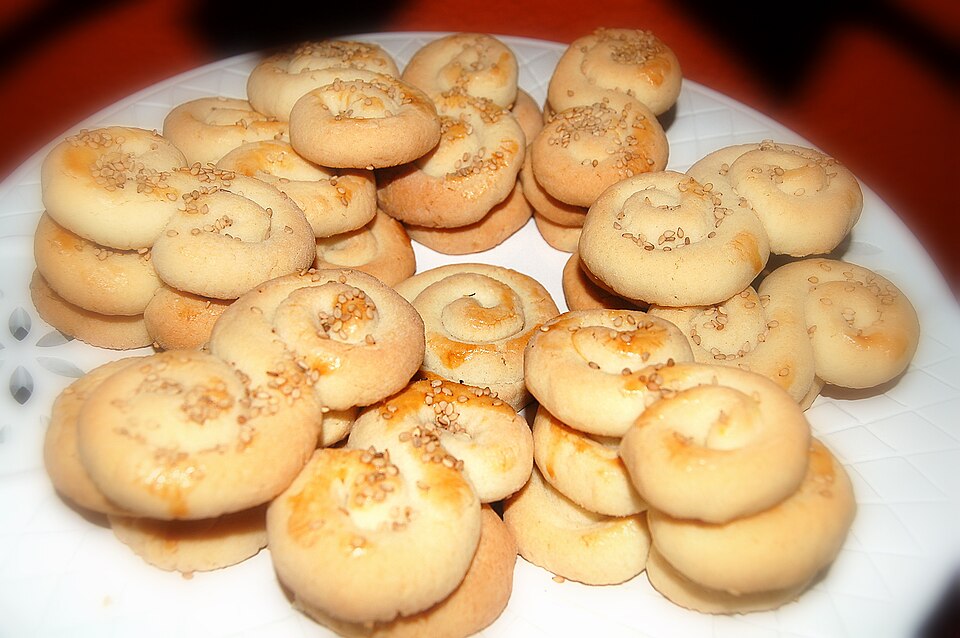
Koulourakia are Greek butter cookies made for Easter, mildly sweet and flavoured with vanilla and orange zest, rolled by hand into twists, braids or coils, and brushed with egg wash before baking for a shiny, golden finish. They are a shaping exercise as much as a baking one.
Koulourakia
- Prep
- 45m
- Cook
- 15m
- Total
- 1h
- Serves
- 30
- Level
- Beginner
Ingredients
Ingredients
Tick ingredients off as you go. Quantities rescale with the buttons above.
Method
- 01Heat the oven to 180C fan 160C and line two baking trays with baking paper.
- 02Beat the butter and sugar together until pale and light, about 3 to 4 minutes.
Butter - 03Beat in the 3 eggs one at a time, then add the vanilla, orange zest and orange juice.
- 04Sift together the flour, baking powder and salt, then fold into the wet mixture in two batches, mixing only until a soft dough forms.
Flour Do not overwork the flour.Yiayia - 05Take a small piece of dough, about the size of a walnut, and roll it into a rope roughly 15 cm long and 1 cm thick.
- 06Fold and twist the rope into your preferred shape, such as a simple twist, braid, or coil, keeping the thickness even.
- 07Place the shaped cookies on the lined trays, spaced apart, and repeat with the remaining dough.
- 08Beat the extra egg and brush each cookie generously and evenly. Scatter with sesame seeds if using.
Sesame Seeds - 09Bake for 13 to 16 minutes, until deep golden all over.
- 10Cool on the trays for 5 minutes, then transfer to a wire rack to cool completely.
Nutrition, per 1 cookie
- Calories
- 132
- Protein
- 2 g
- Carbs
- 17 g
- Fat
- 6 g
- Sat fat
- 4 g
- Fibre
- 0 g
These figures are calculated estimates based on the ingredients listed, not laboratory analysis. Actual values vary with brands, cuts and portion size.
Koulourakia are made in enormous batches in the run-up to Greek Easter, and the actual baking is the easy part. What takes real time, and what every Greek grandmother has her own particular technique for, is the shaping: rolling the dough into ropes and twisting them into braids, spirals or figure-eights by hand, one at a time, usually with a family member or two roped in to help.
The dough itself is straightforward, not far removed from a simple butter cookie dough, sweetened moderately rather than heavily and given warmth with vanilla and orange zest. What makes koulourakia recognisably themselves is entirely in the finishing: a confident egg wash brushed on before baking, which gives that characteristic deep golden shine and a light crackle to the surface.
They keep exceptionally well, which is exactly why a household makes so many at once, since they are eaten steadily through the whole of Easter week rather than in one sitting.
Key preparation steps
- Cream butter and sugar, then work in eggs, vanilla and orange zest.
- Bring the dough together without overworking it.
- Roll into ropes and twist by hand into your preferred shape.
- Brush generously with egg wash and bake until deep golden.
The dough
Butter creamed with sugar until pale and light, then eggs beaten in one at a time, followed by vanilla, orange zest and a little orange juice or brandy for extra flavour. Baking powder gives the finished cookie a slight lift and a tender rather than dense crumb.
Fold in the flour gently and only until it comes together into a soft, workable dough. Overworking the flour at this stage toughens the finished cookie, which should be tender and short, not chewy.
Shaping, the part that actually takes time
Roll a small piece of dough into a rope about 15 cm long, then fold and twist it into whatever shape your family tradition favours, a simple two-strand twist, a tighter braid, a coiled spiral, or a figure-eight. None of these shapes is more correct than another, and this is genuinely the part of the process where every household's koulourakia looks a little different.
Keep the ropes a consistent thickness across the whole batch, since uneven thickness means some cookies bake through before others, leaving you with a tray of mixed doneness.
The egg wash finish
Brush each shaped cookie generously and evenly with beaten egg just before it goes into the oven. This is what gives koulourakia their characteristic deep golden colour and glossy sheen, and a thin or patchy wash leaves visibly pale cookies once baked.
A scatter of sesame seeds pressed gently onto the egg wash is a common traditional addition, giving both extra texture and a slightly nutty flavour against the sweet dough.
What matters in this dish
Do not overwork the flour
Fold it in only until the dough comes together. Overworking it gives a tough, chewy cookie rather than a tender, short one.
Keep the ropes an even thickness
Uneven ropes bake at different rates, leaving some cookies underdone and others overdone on the same tray.
Brush the egg wash on generously
A thin or patchy coat leaves pale, uneven-looking cookies. Cover each one evenly for that characteristic deep golden shine.
Questions people ask about Koulourakia
Why are koulourakia shaped into twists and braids?
It is simply the traditional form these Easter cookies take, and shaping them by hand, often with several family members working together, is as much a part of the Easter preparation ritual as the baking itself. No single shape is more correct than another.
How long do koulourakia keep?
Two to three weeks in an airtight container at room temperature, which is exactly why households make such large batches at once during Easter week.
Can you freeze koulourakia dough?
Yes, the shaped, unbaked cookies freeze well on a tray until solid, then bagged. Bake from frozen, adding a couple of minutes to the baking time.