Greek Main Courses · Northern Greece · Baked · Lent and Nistisima
Greek Baked Giant Beans in Tomato (Gigantes Plaki)
Γίγαντες πλακί YEE-ghan-des plah-KEE · Gigantes plaki
In short
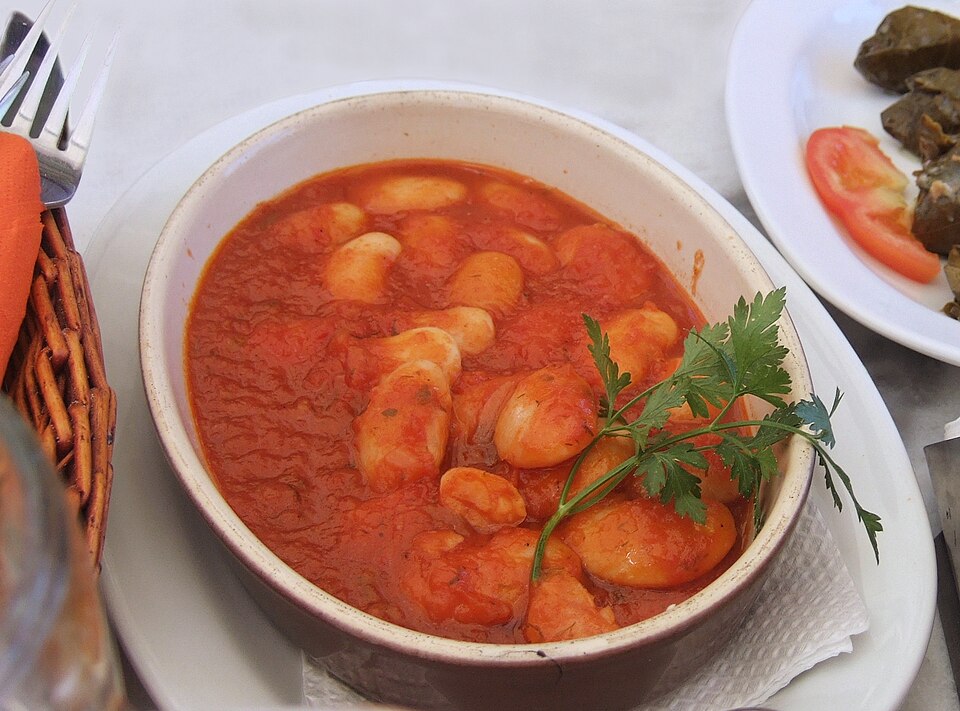
Gigantes plaki is a Greek dish of large white beans baked slowly in a tomato and olive oil sauce with onion, garlic and herbs. It is a ladera dish, meaning the generous quantity of olive oil is the sauce rather than the cooking medium, and it is naturally vegan.
Baked Giant Beans in Tomato
- Prep
- 20m
- Cook
- 1h 45m
- Total
- 2h 5m
- Serves
- 6
- Level
- Beginner
Ingredients
Ingredients
Tick ingredients off as you go. Quantities rescale with the buttons above.
Method
- 01Drain the soaked beans, put them in a large pan and cover generously with fresh unsalted water. Bring to the boil, skim off the foam, then simmer for 40 to 50 minutes until just tender but still holding their shape. Do not add salt or anything acidic yet.Old beans never soften.Yiayia
- 02Drain, reserving 400 ml of the cooking water. Season the beans with salt now.
Salt - 03Heat the oven to 180C fan 160C. In a wide pan, heat the olive oil and cook the onions gently for 12 minutes until soft and sweet. Add the garlic and carrot and cook for 5 minutes more.
- 04Stir in the tomatoes, tomato puree, oregano, paprika and sugar. Simmer for 10 minutes, then add the reserved bean water and season well.
Tomato - 05Combine the beans and sauce in a large baking dish. The beans should be just submerged. Add a little more water if not.
- 06Bake uncovered for 55 to 65 minutes, stirring once halfway, until the sauce has thickened and the surface is browned in patches.
- 07Stir through most of the parsley and the dill. Rest for 20 minutes, then serve warm with the remaining parsley, a final pour of olive oil and plenty of bread.
Dill
Nutrition, per 1 portion
- Calories
- 428
- Protein
- 16 g
- Carbs
- 44 g
- Fat
- 22 g
- Sat fat
- 3 g
- Fibre
- 14 g
These figures are calculated estimates based on the ingredients listed, not laboratory analysis. Actual values vary with brands, cuts and portion size.
Gigantes are large flat white beans grown mainly in northern Greece, in Kastoria and Prespes, and they are a genuinely different thing from an ordinary butter bean: creamier, larger, and able to absorb a great deal of sauce without collapsing. If you can find the Greek ones, buy several bags.
This is a ladera dish, and the word matters. Ladera means cooked in oil, and the quantity of olive oil here is not excessive or a mistake in the recipe. The oil emulsifies with the tomato and the bean starch to become the sauce. Cut it back and you get beans in thin tomato water.
It is also, without any adjustment, completely vegan, which is why it appears on every Greek fasting table. Nobody thinks of it as a vegan dish. It is simply what you eat.
Key preparation steps
- Soak the beans overnight, then simmer until just tender before they go anywhere near tomato.
- Cook the onions slowly and properly in a generous amount of olive oil.
- Combine, then bake uncovered so the top caramelises and the sauce thickens.
- Rest for at least twenty minutes, and serve warm rather than hot.
Why you must cook the beans before adding tomato
Acid stops beans softening. Put raw soaked beans straight into a tomato sauce and they can cook for three hours and still be chalky in the middle, no matter how long you give them.
So the sequence is fixed: soak overnight, simmer in plain unsalted water until the beans are just tender but not falling apart, and only then introduce the tomato. Salt at the end of the simmer too, since salting early also toughens the skins.
Tinned beans work if you are short of time and the dish is still good, but the texture is softer and the beans will not drink up the sauce the same way. If you use them, cut the baking time to about forty minutes.
How much olive oil is right?
For 500 g of dried beans, 150 ml. That is a scant two-thirds of a cup and it will look like a lot in the pan. It is correct.
The oil does three things: it carries the flavour of the onion and garlic through the dish, it emulsifies with the tomato to give the sauce body, and it is what makes the beans taste rich despite there being no animal product anywhere near them. A ladera dish made with a tablespoon of oil is not a healthier version, it is a failed one.
Use a decent extra virgin oil. It is a primary flavour here, not a background one.
Baked or simmered on the hob?
Baked, and uncovered. Plaki refers to a dish baked flat in a tray, and the oven does something the hob cannot: it dries and caramelises the surface while the beans below stay soft, so you get contrast within the same dish.
Simmering on the hob is quicker and perfectly acceptable on a weeknight, but you lose the browned top and the sauce stays looser. If you do it that way, finish under a hot grill for five minutes.
Serving and why it improves overnight
Serve warm or at room temperature, never straight from the oven. Greek ladera dishes are almost always eaten warm rather than hot, which lets the olive oil flavour come forward.
It is genuinely better on the second day. The beans continue absorbing sauce, the oil and tomato settle into each other, and the whole thing tastes rounder. Make it a day ahead if you can.
Feta on the side and good bread are the traditional accompaniments. It is a main course in its own right during fasting periods, and a meze the rest of the time.
What matters in this dish
Old beans never soften
Dried beans more than a year or so old can refuse to cook properly no matter what you do. If a batch is still hard after an hour of simmering, the beans are the problem, not your method.
A pinch of bicarbonate of soda
Adding a quarter teaspoon to the soaking water softens hard water and helps stubborn beans along. Do not overdo it or the beans turn mushy and slightly soapy.
Make it the day before
This dish improves substantially overnight. Reheat gently in the oven, adding a splash of water if it has tightened.
Questions people ask about Gigantes plaki
What are gigantes beans?
Large flat white beans grown mainly around Kastoria and Prespes in northern Greece, with protected designation status. They are creamier and larger than butter beans, though butter beans are the standard substitute.
Can you use tinned beans for gigantes plaki?
Yes. Skip the soaking and simmering, and reduce the baking time to about 40 minutes. The texture is softer and the beans absorb less sauce, but it is a good weeknight version.
Is gigantes plaki vegan?
Yes, entirely, with no adaptation needed. It is a traditional fasting dish and appears on Greek Lenten tables every year.
Why are my beans still hard?
Either they were old, or something acidic went in too early. Acid halts the softening process, so beans must be simmered tender in plain water before the tomato is added.